

This consultation was open from:
March 28, 2024
to May 27, 2024
Decision summary
This notice invited comments on the Southwestern Ontario Transportation Planning Study, which delivers on a commitment in Connecting the Southwest: a draft transportation plan for southwestern Ontario and is intended to support government decision-making to improve the transportation network. The feedback received has informed updates to the study
Decision details
The Southwestern Ontario Transportation Planning Study is a multimodal technical study examining current and future transportation demands, gaps, and opportunities in southwestern Ontario and its connections to the U.S. and the rest of Ontario.
The proposal focused on identifying a draft list of potential infrastructure, policies, programs, and other strategies to address regional transportation needs in a long-range transportation plan with a time horizon out to 2051.
Supporting materials that were included as part of the consultation are listed below:
- Phase 1 Summary – Study Purpose, Approach, and Key Findings of the Socio-Economic Forecast, Macroeconomic
- Phase 2 Summary – Summary of Needs and Opportunities for Air, Marine, Rail, Roads, and Transit Modes
- Phase 3 Summary – Developing the Draft List of Options and Evaluation Framework
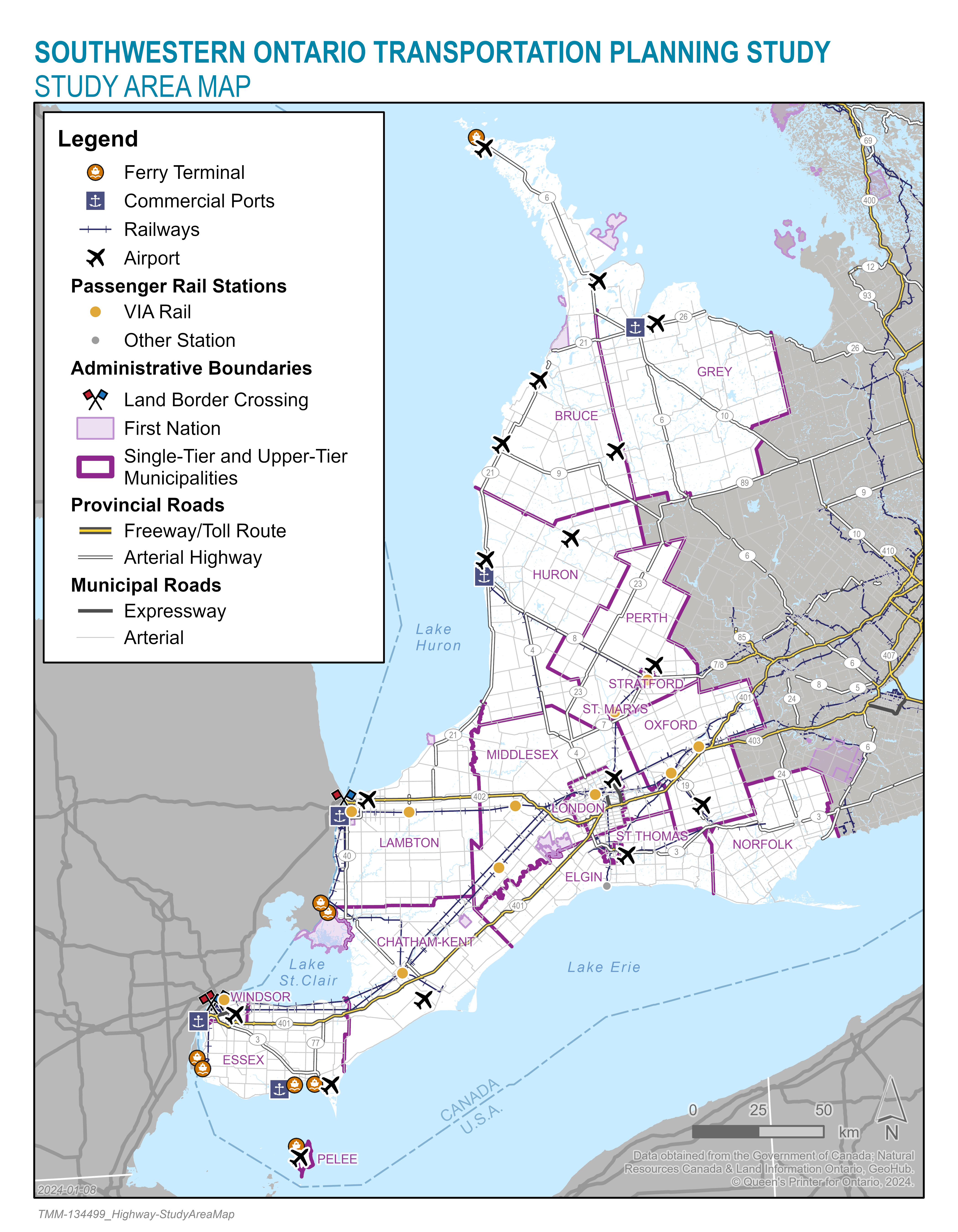
- Study Area Map – Major Transportation Infrastructure and Administrative Boundaries
This proposal sought public feedback on the first three of four phases to ensure local perspectives and priorities informed the study’s development.
In addition to the proposal posted to the Environmental Registry of Ontario, an online survey was available on the EngageON platform from March 2024 to May 2024 to gain further insights on the transportation preferences of residents, workers, businesses, and other users of the transportation network in the region.
A total of 154 participants responded to the survey. Participation was voluntary and anonymous. Responses were received from individuals, businesses, and other groups across southwestern Ontario, including a Mennonite community that submitted mailed responses.
The survey asked for feedback on how well the study’s goals address current and future transportation challenges in southwestern Ontario, how important those goals are, what outcomes people want from the study, and how well proposed options support each goal. Overall, responses were neutral in tone, with many responses offering suggestions.
Most respondents (78%) felt the study’s goals address transportation challenges well or very well. The goals rated as most important were: Goal 1 – Ensure people get where they want to go as efficiently as possible, and Goal 3 – Offer good options for those who don’t want to or can’t use cars.
After reviewing all comments and incorporating them into the study where appropriate, a decision was made on March 6, 2026 to close this proposal and update the public on the changes and status of the study.
Based on the feedback received, MTO made the following updates (described in more detail in the Effects of Consultation section below):
- Added a new study goal for ‘Improving Equity and Inclusion’ to ensure the transportation system meets everyone’s needs, with a focus on strengthening connections to critical services for Indigenous people.
- Updated the identified needs and opportunities across air, marine, rail, roads, and transit transportation in the region.
- Revised existing options and added new ones for further evaluation in the study.
Effects of consultation
A summary of the comments received through the ERO and a public survey is provided below and are being considered as the Southwestern Ontario Transportation Planning Study progresses.
All feedback was considered and updates to the study’s goals, objectives, and options have been incorporated to strengthen the study’s recommendations.
Phase 1: Goals and Objectives
Respondents were supportive of the Goals and Objectives outlined in the Phase 1 Summary:
- Connecting People and Places
- Supporting a Competitive Business Environment
- Providing More Choice and Convenience
- Increasing Health, Safety and Inclusion
- Preparing for the Future
- Ensuring Environmental Sustainability
Overall, comments generally pertained to transportation safety, supporting accessible public transit, and support for specific road improvements.
Recommendations included creation of a new goal, and associated actions related to implementing solutions to systemic transportation gaps and barriers faced by Indigenous communities. One change is proposed to establish Goal 7 with an Objective based on collected feedback:
New Goal 7: “Improving Equity and Inclusion”: Ensure the transportation system is inclusive of everyone’s transportation needs.
- New Objective: Strengthen the local and regional public transportation connections to critical services, such as hospitals, post-secondary education, and social services for Indigenous people.
Phase 2: Summary of Needs and Opportunities for Air, Marine, Rail, Roads, and Transit Modes
Feedback on Phase 2 highlighted several key needs and opportunities across the transportation system:
- Improve highway safety and maintain infrastructure in good condition.
- Increase funding for roads and bridges for maintenance and replacement.
- Ensure that roads can safely accommodate large slow-moving farm equipment travel between farm fields.
- Maintain ferry capacity to support farm businesses.
- A need for stable and sustainable funding for rural transit services, improvement of transit connections and travel frequency for bus and rail.
- Ensure bus routes connect Indigenous communities to essential services like affordable grocery stores and housing.
- Couple transit-oriented development with permanently affordable housing development, including social housing.
- Collaborate with Indigenous communities and organizations to combat violence and human trafficking against Indigenous women and girls through training to increase recognition and reporting, posting educational material with the Canadian Human Trafficking Hotline.
- Work with key partners, including MTO agencies and Indigenous organizations, to increase awareness of human trafficking in alignment with the Calls to Justice of the National Inquiry into Missing and Murdered Indigenous Women and Girls and Anti Human trafficking (MMIWG & AHT) and increase public transit funding to address these issues.
- Support active transportation and improve safety at trail crossings along Provincial highways to ensure transportation networks support the tourism industry.
- Install EV charging stations at rest areas for commercial and passenger vehicles.
- Conduct Agricultural Impact Assessments to mitigate the impacts of non-agricultural development on farming operation, and identify methods to avoid, minimize, and mitigate adverse impacts.
Phase 3: Summary – Developing the Draft List of Options and Evaluation Framework
Comments related to Phase 3 were incorporated in two ways: revisions to existing options; and creation of new options.
A summary of existing options that were improved for further consideration is provided below:
- Expanding sustainable transportation options by considering using linear corridors for new active transportation and transit routes, including rail.
- Collaborate with private partners to encourage private investment in clean technology solutions for people and goods movements including for road, air, marine and rail-based modes.
- Continue improving road safety on highways and rural roads.
- Collaborate with Indigenous organizations to combat violence against Indigenous women and girls and human trafficking and improve transportation facilities such as rest areas safer through infrastructure upgrades such as site clearing, improved lighting and security cameras.
The following new options are being considered in the study:
- Work with other levels of government and the industry to explore initiatives aimed at developing a new intermodal facility in southwestern Ontario.
- Leverage the transportation system as a platform to recognize Indigenous places and histories through naming, design, landscaping and art.
- Investigate opportunities to reduce the impact of road salt and other de-icers on watercourses and wetlands while maintaining safe road conditions in winter.
- Protect infrastructure and land associated with rail, marine, air and road systems to preserve them for potential future transportation-related uses.
- Explore opportunities to support Indigenous communities and organizations in transportation planning, maintenance and operations across all modes, including potential funding programs and regional coordination with other transportation agencies.
The study’s findings are intended to support government decision-making to improve the transportation network with a long-term vision out to 2051. Recommended actions would be subject to further prioritization, project-specific studies and approvals, such as Environmental Assessment studies, consultation with Indigenous communities and the public, and funding approval before they move forward.
Supporting materials
View materials in person
Some supporting materials may not be available online. If this is the case, you can request to view the materials in person.
Get in touch with the office listed below to find out if materials are available.
438 University Ave, 12th Floor
Toronto,
ON
M5G 2K8
Canada
Connect with us
Contact
MTO ERO
438 University Ave
12th Floor
Toronto,
ON
M7A 1N3
Canada
Original proposal
Proposal details
Connecting the Southwest: A Draft Transportation Plan for Southwestern Ontario (Connecting the Southwest) was released in January 2020. Connecting the Southwest includes 5 goals and 43 actions to:
- Get people moving and connect communities
- Support a competitive open for business environment
- Improve safety
- Provide more choice and convenience, and
- Prepare for the future
Connecting the Southwest is considered a “living document” that will be reviewed and updated on a regular basis to incorporate the assessment of future transportation needs.
To support this assessment, MTO is undertaking the Southwestern Ontario Transportation Planning Study (the “study”), a technical multimodal study that will examine the current and future transportation demand, gaps, and opportunities across Southwestern Ontario and connections to the USA and the rest of Ontario.
The study seeks to identify and consider a broad range of transportation needs and opportunities which will be reflected in the scope of the study’s recommendations, including possible new programs that promote greater climate resiliency and actions that reduce the environmental impact of transportation systems.
The study includes economic and demographic forecasting, long-range transportation network modelling and travel demand forecasting, scenario testing, policy development, and engagement. The work will result in recommended transportation infrastructure networks, policies, and program initiatives for southwestern Ontario to the horizon year of 2051.
During the first three phases of this study, the focus is to identify potential infrastructure, policies and programs that would address the transportation needs and opportunities in the region, which includes identifying any negative impacts to the environment from the transportation network. Environmental impacts that have been identified so far in the study and potential mitigation strategies are outlined in this proposal.
In the fourth phase of this study, these potential infrastructures, policies and programs will be evaluated and prioritized to formulate a network plan to support government decision-making with short, medium, and long-term solutions. Environmental impacts will be one of the main considerations for evaluation in Phase 4 to determine the recommended solutions for the region, which will be covered by another Environmental Registry of Ontario Posting in the future.
The study recognizes that the final recommended transportation infrastructure, policies, and programs will potentially have both positive and negative environmental impacts. The study itself will not result in new infrastructure, policies, or programs, but will inform future decision-making related to transportation in the province which may have impacts on the environment at the time of implementation.
An example of potential positive environmental impacts is a program that aims to improve the competitiveness of non-auto options and to promote the use of transit thereby reducing total greenhouse gas emissions from the transportation sector.
An example of potential negative environmental impacts identified in the study could be the inadvertent introduction of invasive species to the region from increased rail-based shipping as a result of reduced freight movement on highways in effort to minimize traffic congestion on the road. The study will explore growth management approaches and examine and mitigate adverse impacts to the environment.
After the completion of this study, recommended transportation infrastructure, policies, and programs that obtain additional government approvals will be subject to additional environmental reviews at the implementation stage, such as more detailed environmental assessment and public consultation as required by the applicable legislation.
MTO will continue to work with and seek feedback from Indigenous communities and organizations, local municipalities, stakeholders, and the public throughout this study’s process.
Feedback received in response to this posting will inform recommended improvements to the transportation network in the southwestern region.
Please refer to the supporting materials attached to this posting and visit the related links below to learn more. As you read through these supporting materials, please consider answering the following discussion questions:
- After reviewing the Goals and Objectives outlined in the Phase 1 Summary attached, what would you offer as feedback for the ministry to consider? What would you change, if anything?
- After reviewing the Needs and Opportunities outlined in the Phase 2 Summary attached, what do you think are the most significant barriers when travelling or moving goods in southwestern Ontario? Are these barriers addressed in the attached materials? If not, please provide detail.
- After reviewing the Draft Options outlined in the Phase 3 Summary attached, how well do you think these will address the gaps and opportunities for transportation in the region? What options do you think are missing that should be added? What refinements would you make to the wording of any options presented?
- What community connections are missing in the presentation materials that you regularly travel to and think should be better connected to the transportation network?
- How do you think the planning study addresses potential impacts to the environment? Is there anything that is not outlined that should be added for consideration?
Please also complete our Online Survey to provide your feedback on the Study’s goals, outcomes, and long list of options.
Supporting materials
View materials in person
Some supporting materials may not be available online. If this is the case, you can request to view the materials in person.
Get in touch with the office listed below to find out if materials are available.
438 University Ave, 12th Floor
Toronto,
ON
M5G 2K8
Canada
Comment
Commenting is now closed.
This consultation was open from March 28, 2024
to May 27, 2024
Connect with us
Contact
Katerina Downard
438 University Ave
12th Floor
Toronto,
ON
M7A 1N3
Canada
Comments received
Through the registry
8By email
0By mail
0