

Commentaire
How does the proposed amalgamation of the CAs reduce red tape and ensure the following when evaluating vendors, technologies, and governance models for regionalized Conservation Authority operations—including digital‑twin infrastructure, watershed modeling, real‑time hazard monitoring, and public‑facing decision tool.
In particular, how does the increased land use and land cover mapping support Infrastructure Ontario's digital twin initiative? How will the new CA's develop the capacity to:
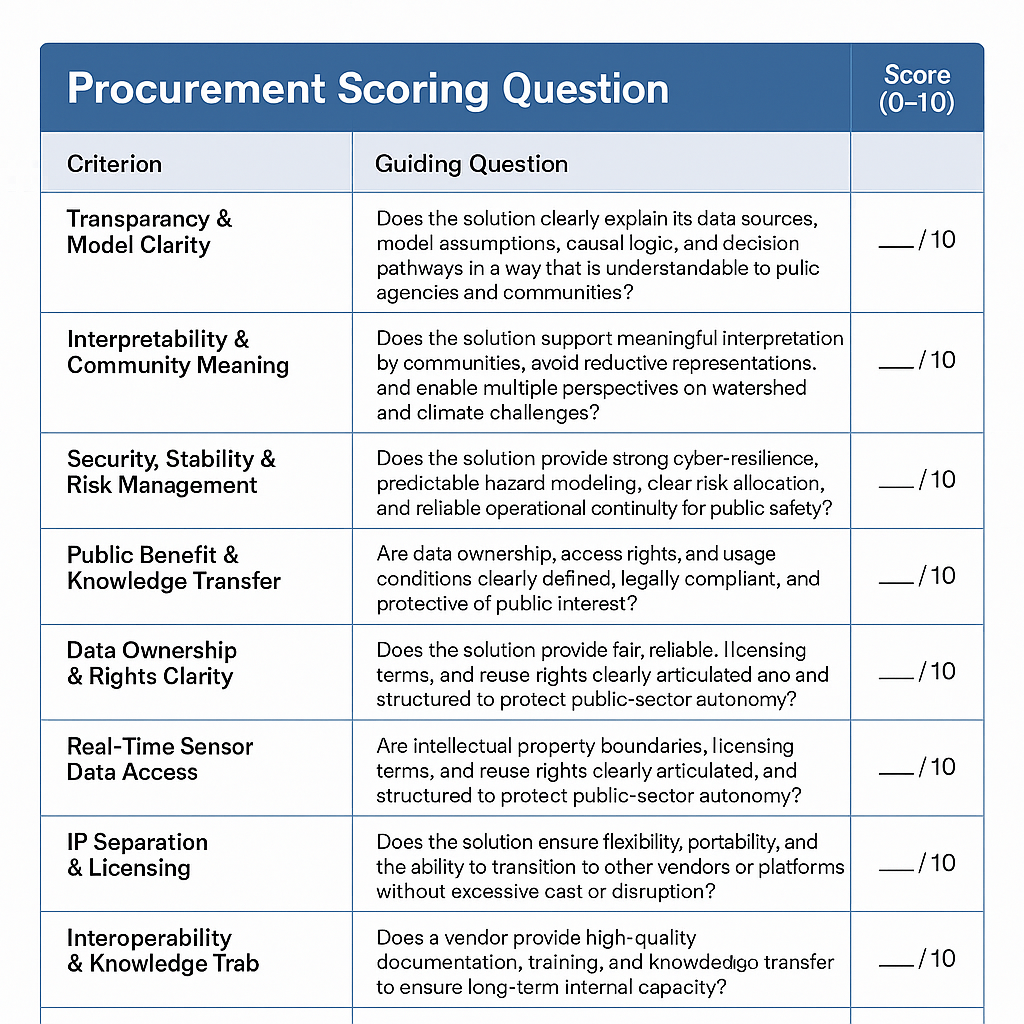
1. Clearly explain its data sources, model assumptions, causal logic, and decision pathways in a way that is understandable to public agencies and communities?
2. support meaningful interpretation by communities, avoid reductive representations, and enable multiple perspectives on watershed and climate challenges at the municipal and regional level (e.g., indigenous and Areas of Scientific Interest).
3. How will the new CAs provide strong cyber‑resilience, predictable hazard modeling, clear risk allocation, and reliable operational continuity for public safety?
4. how will the new CAs enhance civic capacity, support education and workforce development, and provide long‑term public value beyond the immediate technical deployment?
5. How will the new CA statutory structure address IP and other legal issues related to sharing real-time environmental monitoring data to support predictive analytics (i.e., data ownership, access rights, and usage conditions clearly defined, legally compliant, and protective of public interest)?
6. Related to number 5 is how will the new CA structure support a digital first strategy based on an open source foundation that provides fair, reliable, and clearly governed access to real‑time sensor data without unnecessary restrictions or proprietary barriers?
7. How will the new CAs address the issue of intellectual property boundaries, licensing terms, and reuse rights clearly articulated and structured to protect public-sector autonomy?
8. How will the new CA structure adhere to open standards, integrate with existing systems, and avoid proprietary lock‑in?
9. How will the new CA structure ensure flexibility, portability, and the ability to transition to other vendors or platforms without excessive cost or disruption?
10. How will the provincial government work with the federal government to support the new CA structures and mandates to provide high‑quality documentation, training, and knowledge transfer to ensure long‑term internal capacity?
11. Will the new CAs have a clear, feasible, and well‑structured exit strategy that preserves public control and operational continuity?
Documents justificatifs
Soumis le 22 décembre 2025 12:48 PM
Commentaire sur
Proposition de limites pour le regroupement régional des offices de protection de la nature de l’Ontario
Numéro du REO
025-1257
Identifiant (ID) du commentaire
178372
Commentaire fait au nom
Statut du commentaire